To start a travel eSIM business, pick a traveler niche, choose a business model (affiliate, white-label storefront, API integration or a full build), partner with a wholesale or white-label eSIM provider that covers your destinations, set pricing that leaves room for acquisition costs, and then build distribution and support. For most new brands the white-label route is the practical one: the provider runs carrier connections, provisioning and billing, and you own the brand, the storefront and the customer relationship.
This guide walks through that path in order, from the first decision to a four-week launch plan. It also covers how a branded eSIM storefront or marketplace works behind the scenes, what makes launching one hard, and a checklist for judging providers.
Last verified 4 November 2026.
The short version: the telecom part is rented, the business part is yours. Choose a niche, pick the model that gives you the customer relationship you want, price for repeat purchases rather than the lowest sticker price, and treat support as part of the product.
Why travel eSIMs are a real business opportunity
Travelers now expect to land, scan a QR code and be online, without hunting for a local SIM or paying roaming fees. International travel keeps growing: UN Tourism reported roughly 307 million international arrivals in the first quarter of 2026, about 2% more than a year earlier, though it also warned of headwinds, including conflict in the Middle East (UN Tourism). Every arrival is a person who may need data in a country where their home plan is expensive or unavailable.
The other half of the picture is devices. The GSMA consumer eSIM specification, SGP.22, defines how a phone downloads and manages an operator profile remotely instead of taking a physical card, and recent flagship phones from the major makers support it. Our guide to remote SIM provisioning explains the mechanics, and the GSMA eSIM overview covers the standards.
The product itself suits a small team. A travel eSIM is entirely digital, so there is no stock, shipping or warehouse. The customer pays online, receives an activation QR code, installs the profile and connects to a local network. You buy connectivity at wholesale rates and sell it under your brand. Margins depend on destination, supplier terms and how much you spend to win each customer, so model them with your own quotes rather than a rule of thumb.
Step 1: Pick a niche and the coverage it needs
The most common early mistake is trying to serve every traveler. A narrow niche gives you a clear message, cheaper marketing and a reason to exist next to much larger consumer brands. Segments that work as starting points:
- Business travelers who need data on arrival and a receipt for expenses
- Digital nomads who move between countries and need regional or multi-country plans
- Students studying abroad, who need weeks or months of data
- Cruise passengers and adventure travelers with unusual routes
- Pilgrimage and group travel organizers buying for many people at once
- Existing customers of a travel agency, tour operator or community
- Travelers to one region, such as Europe, Japan, Southeast Asia or the Middle East
A travel agency selling European holidays can bundle a regional plan into every package. A creator who films backpacking trips can recommend the exact plan for each route. In both cases the niche decides which destinations your catalog needs first, and that decides which provider you can use.
Step 2: Choose your business model
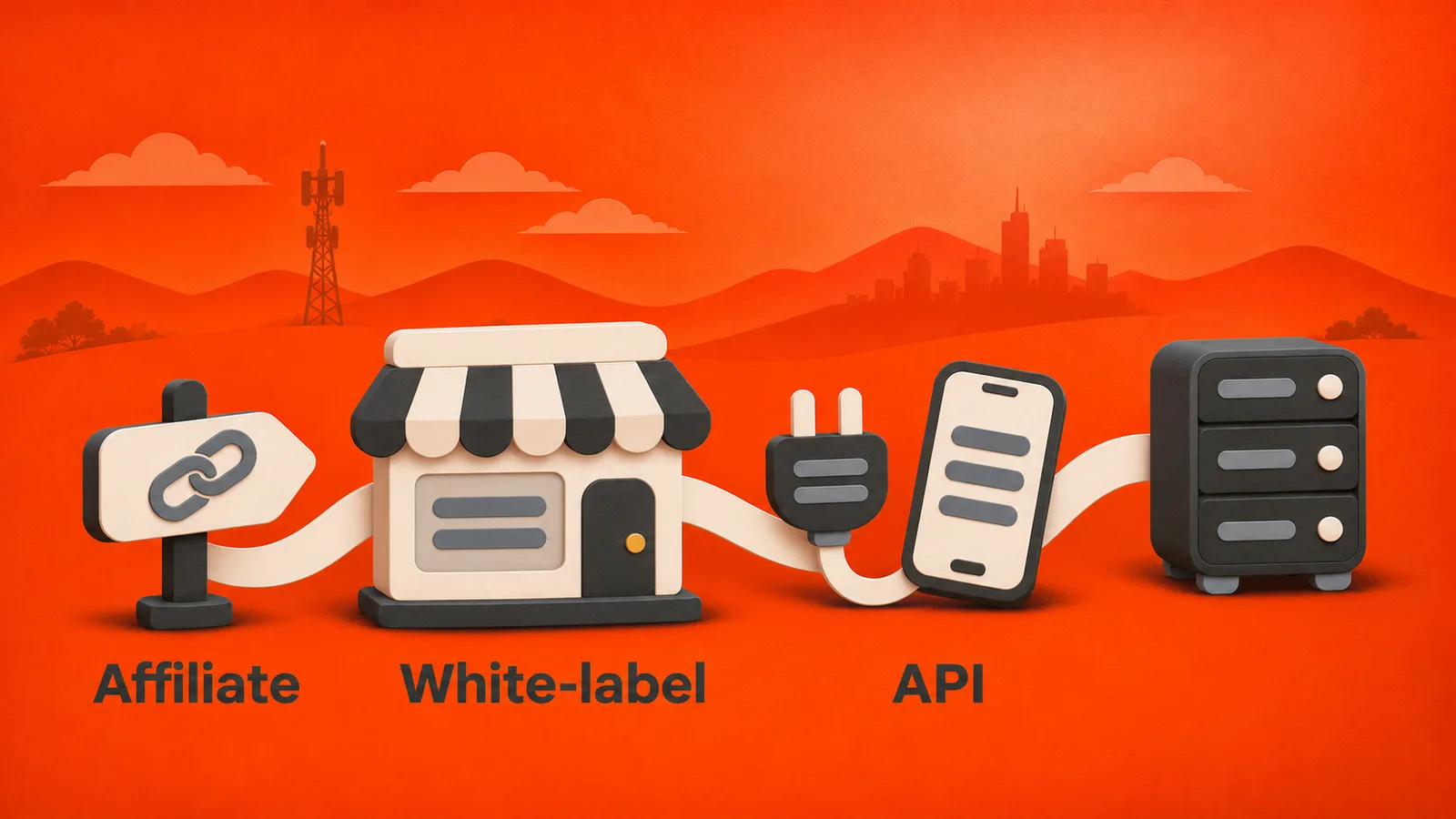
There are four ways in. They differ in how much you invest, what you own and how much you can change.
| Model | Brand | Customer relationship | Revenue | Effort | Best for |
|---|---|---|---|---|---|
| Affiliate | Provider’s | Provider’s | Referral commission | Low | Bloggers and creators testing demand |
| White-label storefront | Yours | Yours | Wholesale cost plus your retail price | Low to medium | Travel brands, agencies, startups |
| API or SDK integration | Yours | Yours | You set the price in your own app | Medium to high | OTAs, travel apps, software platforms |
| Build the platform | Yours | Yours | Full control over price and features | Very high | Telecom operators and large enterprises |
Affiliate is the fastest start. You share another company’s link and earn a commission, and the provider handles checkout, provisioning and support. The cost is that customers buy on someone else’s site, you do not own the relationship, and the commission is set by them.
White-label is a different business. A provider runs the telecom infrastructure while you sell under your own name, set your own prices and own the customer data. You can build an email list, run loyalty and referral programs and market to people again before their next trip.
API or SDK integration suits companies that already run a booking flow. The eSIM becomes a step in checkout, so the traveler never leaves your app.
Building from scratch means carrier agreements, provisioning systems, billing and compliance. It gives maximum flexibility and is impractical for most startups. If you are weighing it, read our breakdown of what a launch actually costs and how an enabler shortens it.
For most new businesses the white-label model balances speed, margin and ownership, so the rest of this guide assumes it.
The white-label route: how a branded eSIM storefront works
A branded eSIM storefront, sometimes called a marketplace, is a website or app where you sell connectivity plans under your own brand. Customers browse destinations, buy, and activate on their phones. A technology provider handles the connection to mobile networks, profile provisioning and the platform behind the scenes. The same idea underlies white-label MVNO services, where a company sells mobile service on a partner’s infrastructure.
Day to day, the split looks like this:
| You handle | Your provider handles |
|---|---|
| Brand, website or app, and the plan catalog | Carrier relationships and network connections |
| Pricing, promotions and margins | Profile provisioning and the activation flow |
| Marketing, partnerships and customer acquisition | Platform, billing and usage records |
| First-line customer support | Escalations tied to the network or the platform |
Spenza’s platform is one example of this kind of provider. It combines multi-carrier eSIM access, a white-label storefront, API or Shopify integration, and plan, pricing and provisioning controls in one dashboard. See how selling devices and eSIMs on Shopify works, and the white-label overview for service providers.
Be honest about what is hard even when someone else runs the network:
- Technical. Provisioning, activation and network integration involve several systems that must agree. A partner with a mature platform spares you from building and maintaining them.
- Operational. Travelers need help at any hour and in many languages, because a failed activation in an airport cannot wait. Multi-currency payments and refunds add more work.
- Regulatory. Telecom licensing, privacy law and consumer protection rules differ by country. Using a compliant provider moves much of the network side to them, but you still own your own marketing claims, refund policy and data handling.
Step 3: Choose a supplier with the right coverage
Not all wholesale providers are equal. Some rely on a single operator in each country, which can keep costs down but leaves gaps where that operator is weak. A multi-carrier provider lets compatible devices attach to more than one partner network where supported. That tends to widen coverage and reduce the connection problems that produce refund requests and bad reviews.
Use this checklist when you compare providers:
| Criterion | What to ask | What good looks like |
|---|---|---|
| Coverage | Which countries and regions? How many networks per destination? | Your priority destinations, with more than one network where possible |
| Network quality | Which operators and generations (4G, 5G)? What happens if one fails? | Named partners and a clear failover description |
| Plan flexibility | Can you set plan sizes, validity and bundles? Regional and country plans? | Control over your own catalog and prices |
| API and docs | Is the API documented? Is there sandbox access and developer support? | Clear docs and a way to test before you commit |
| Branding | Can you use your domain, emails and activation pages? | The traveler sees only your brand |
| Compliance | How are privacy, data security and regional rules handled? | Written answers, not a verbal assurance |
| Commercials | Minimums, platform fees, wholesale rates, payment terms? | A quote you can model against your margin |
| Time to launch | What does onboarding involve, and who does the work? | A realistic plan with named owners |
Ask for the answers in writing and test a few plans on real phones in your target countries before you commit. Our guide to mobile eSIM plans shows how plans are structured, which helps when you read a wholesale rate card.
Step 4: Build the brand, storefront and app
Connectivity is only half of what the customer buys. The other half is how easy the purchase feels. Travelers usually compare several providers, so your site should let them find a destination, compare plans and check out in a couple of minutes.
- Organize plans by destination, region, trip length or data allowance rather than listing hundreds of products.
- State supported countries, validity period, device compatibility and activation steps on every plan page.
- Show trust signals: transparent pricing, a clear refund policy, reviews once you have them and a real FAQ.
- Add a device compatibility check before payment, since a locked or unsupported phone is the most avoidable refund.
Shopify or WooCommerce give you a store with payments, discounts and order management already built, which is the quickest way to launch a standalone brand. Our guide to reselling data plans on Shopify covers the setup and the delivery step in detail.
API or SDK integration fits travel apps, airline and hotel booking systems and corporate travel portals, where the eSIM is offered at the moment of booking. If you already have a device or hardware angle, the travel eSIM for devices guide shows a related route. Whatever the platform, aim for a purchase that feels as simple as booking a hotel.
Step 5: Set pricing and margins
The lowest price attracts customers and starves the business. If you cannot fund marketing, support and refunds, you cannot grow. Price for sustainable margin instead.
Start by looking at what established consumer brands charge, such as Airalo, Holafly, Nomad and Saily, for the same destinations, data sizes and validity. That gives you a market benchmark and shows where you can differentiate through bundles, support or regional expertise rather than price alone.
Then work backwards from your own numbers: wholesale cost per plan, payment fees, support cost per order and customer acquisition cost. Margin is what is left after all of those, so a high markup on paper can still lose money if ads are expensive. Your wholesale agreement and promotions change the result, which is why you need a real quote before you set retail prices.
Finally think about lifetime value. A traveler who buys three or four plans a year is worth far more than one who buys once. Pricing that rewards the second purchase, such as credits or loyalty tiers, often beats squeezing every sale.
Step 6: Build distribution
A storefront does not bring its own traffic. Many launches spend months on the site and almost nothing on acquisition. Combine channels rather than relying on one:
- Search content. Articles such as “best eSIM for Japan”, “eSIM vs international roaming” and “how to activate an eSIM on iPhone” reach people who are already planning a trip.
- Paid ads. Useful around seasonal travel and popular destinations, as a complement to organic traffic.
- Email. The cheapest repeat channel, because it reaches people who already trust you.
- Affiliate and creator partners. Creators can run their own branded store through a white-label platform and keep the customer list, instead of earning a small commission.
- Travel agencies and OTAs. Bundling an eSIM with flights, hotels, tours or insurance adds revenue without changing the sales process.
- Referral programs. Credit for a successful referral lowers acquisition cost and adds trust.
Track customer acquisition cost, conversion rate, average order value, repeat purchase rate and customer lifetime value. These show the health of the business better than revenue alone. For partner-led models, see how service providers monetize connectivity and what telecom as a service means for resellers.
Step 7: Support and retention
Many travelers are installing an eSIM for the first time, so support is part of the product. Clear help also cuts refund requests and support cost. Consider:
- Step-by-step activation guides for iPhone and Android
- Short video tutorials
- A device compatibility checker
- Destination-specific FAQs
- Live chat or email support with a clear response time
- Self-service troubleshooting for the common failures, such as data roaming left off
Retention follows from the same habit. People travel more than once a year, so loyalty credits, destination suggestions, seasonal offers and pre-trip reminders bring them back to you instead of the next search result.
A four-week launch plan
You can validate the idea and acquire early customers in about a month if you keep the scope small. Treat the schedule as a planning target, since provider onboarding and payment setup can take longer than expected.
| Week | Focus | Key actions |
|---|---|---|
| 1 | Research and planning | Pick your niche, review competitors, shortlist providers, request quotes and decide on the business model. |
| 2 | Build and configure | Set up the storefront, load products, set prices, connect payments and publish support pages. |
| 3 | Marketing | Publish destination content, prepare ads and email automations, contact creators, agencies and partners. |
| 4 | Launch and optimize | Go live, test real purchases on real devices, collect feedback, adjust pricing and focus on the best channels. |
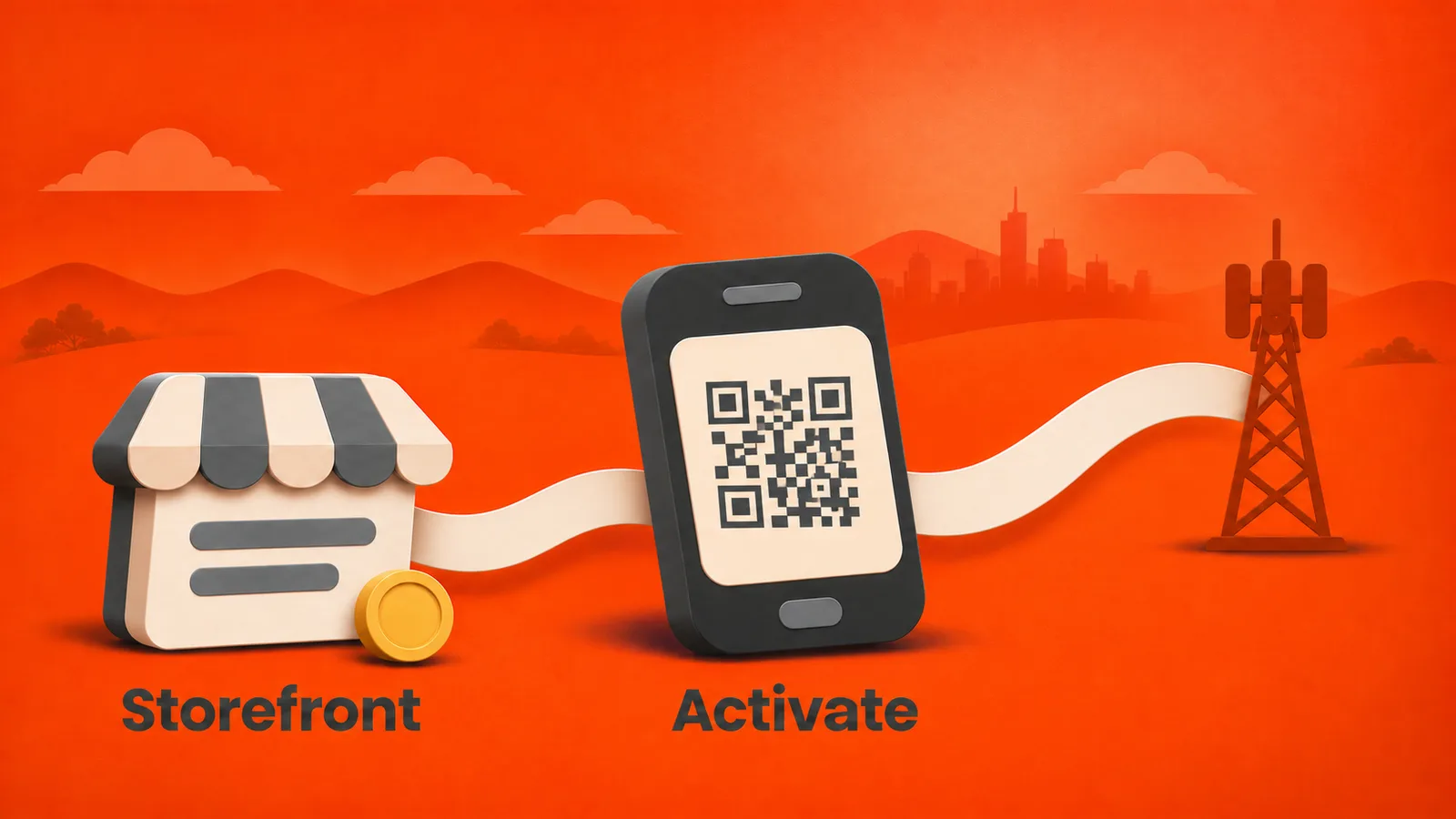
The first month is for learning, not perfection. Early purchases and support tickets will tell you more about your catalog, messaging and pricing than any plan on paper.
Common mistakes to avoid
- Launching with hundreds of destinations when your niche needs ten.
- Choosing a supplier on rate alone and finding coverage gaps after launch.
- Skipping device compatibility checks and absorbing the refunds.
- Pricing at the bottom of the market without modeling acquisition cost.
- Treating the launch as the finish line and leaving distribution until later.
- Making refund, privacy and coverage claims without checking the rules in each country you sell to.
If your plans extend to hardware, such as selling devices with eSIM bundled in, the eSIM for OEMs guide covers that side.
Conclusion
Starting a travel eSIM business is mostly a set of choices, not a build. Pick a niche, choose the model that gives you the customer relationship you want, partner with a provider whose coverage matches your destinations, and price for margin and repeat purchase. Distribution and support then decide whether the business grows.
Because the telecom side can be rented, a small team can launch in weeks. What lasts is the brand, the audience and the customer list you build on top of it.
Frequently asked questions
How do I start a travel eSIM business?
Choose a traveler niche, decide on a business model, and partner with a wholesale or white-label eSIM provider that covers your destinations. Then build a storefront, set pricing, create acquisition channels and prepare support. With a white-label platform you do not need to build telecom infrastructure or manage carrier relationships yourself.
Is a travel eSIM business profitable?
It can be. The product is digital, so there is no inventory or shipping, but profit depends on wholesale cost, payment fees, support cost and customer acquisition cost. Brands that earn repeat purchases and keep acquisition costs low do better than those competing on price alone.
How much does it cost to start a travel eSIM business?
Costs are lower than in traditional telecom because there is no stock or network to build. Expect platform or integration fees, a website or store, branding, payment processing and marketing. Ask providers for written quotes with minimums and fees so you can model your own break-even.
Can I sell travel eSIMs on Shopify?
Yes. Many sellers use Shopify or WooCommerce for storefront, payments and order management, with the provider delivering the eSIM after purchase. If you run a travel app or booking platform, an API or SDK integration lets customers buy inside your own checkout.
Do I need a telecom license to sell travel eSIMs?
Often not, when you resell through a compliant wholesale or white-label provider that holds the carrier relationships. Rules vary by country, and you remain responsible for your own marketing claims, refunds and data handling. Check local business and consumer protection requirements, and ask a lawyer where you are unsure.
What is the difference between affiliate and white-label?
An affiliate sends traffic to another company’s store and earns a commission, so the provider owns the customer. A white-label business sells under its own brand, sets its own prices and owns the customer relationship. White-label takes more setup but builds an asset you control.
How do I compete with established travel eSIM brands?
Do not compete on price alone. Focus on a niche, offer reliable coverage, make activation and support easy, and use distribution the large brands neglect, such as agency bundles, creators and community partnerships. Owning the customer relationship also improves retention.
What should I look for in a white-label eSIM provider?
Check coverage in your destinations, the number and quality of networks, plan flexibility, API quality, branding options, compliance handling and onboarding time. Ask for the answers and the commercial terms in writing, and test plans on real devices before you commit.