Last verified 30 October 2026.
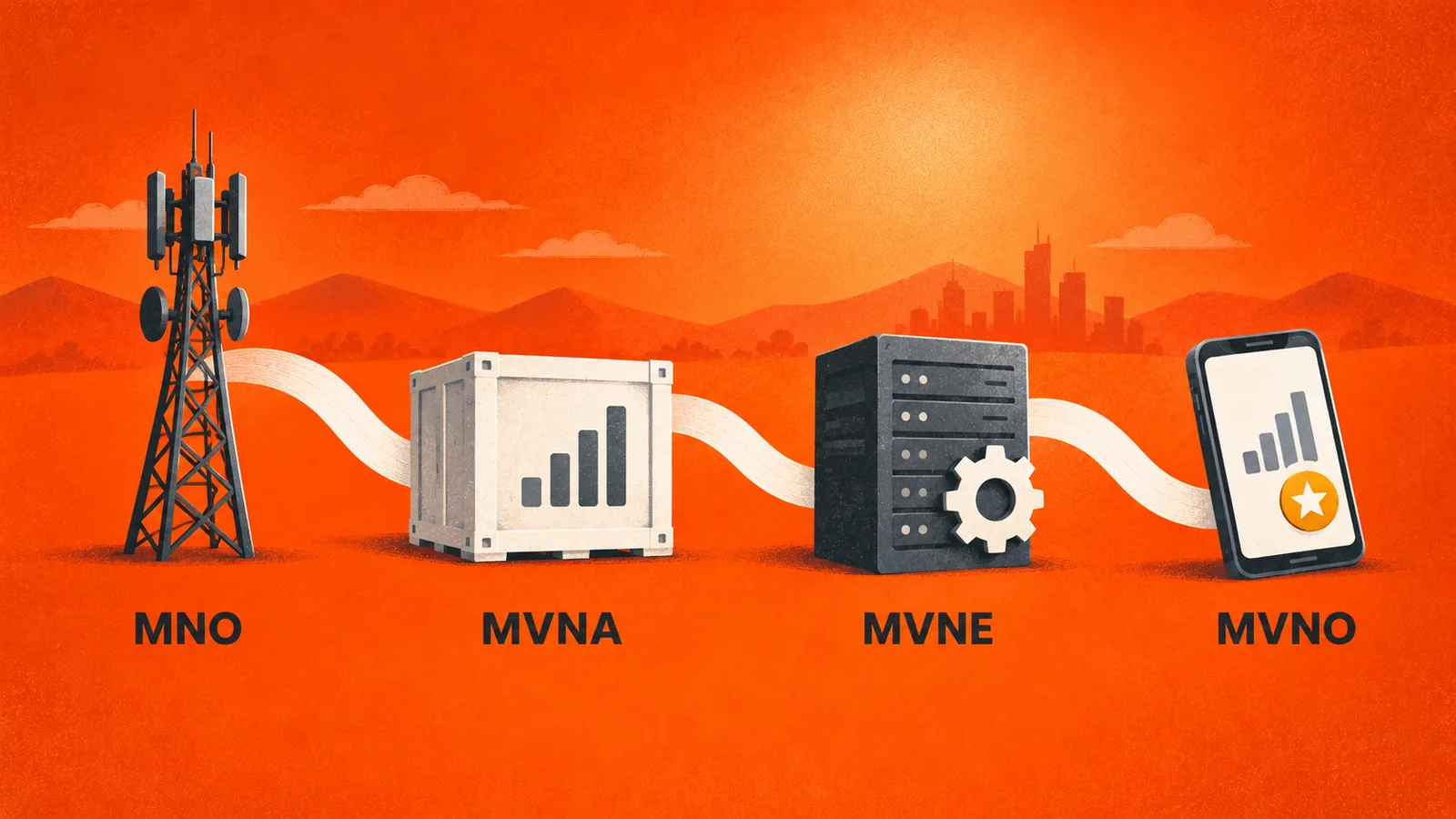
An MVNE (mobile virtual network enabler) is a company that supplies the systems and operations a mobile brand needs to run its service: provisioning, SIM and eSIM management, rating and billing, customer-care tools and the integration to a host network. It does this without being the brand customers buy from. In the full chain, an MNO runs the radio network, an MVNO sells mobile service under its own brand on that network, an MVNE enables the MVNO, and an MVNA aggregates wholesale network access for many MVNOs.
These are roles, not four companies in a fixed line. One supplier can fill several of them, and the labels are used loosely across the industry. This guide defines each role, compares them pair by pair, shows who owns the network, the customer, the BSS/OSS and the wholesale agreement in each, and ends with a short method for deciding which partner a given launch needs. For the wider picture of launching, start with what an MVNO is.
What is an MVNE?
MVNE stands for Mobile Virtual Network Enabler. An MVNE provides the technical and operational layer that sits between a host network and a mobile brand: the platform that activates a SIM, applies a plan, records usage, produces the invoice and hands a failed order to someone who can fix it. It does not sell mobile service to the public under its own name. Its customer is the MVNO, or a company becoming one.
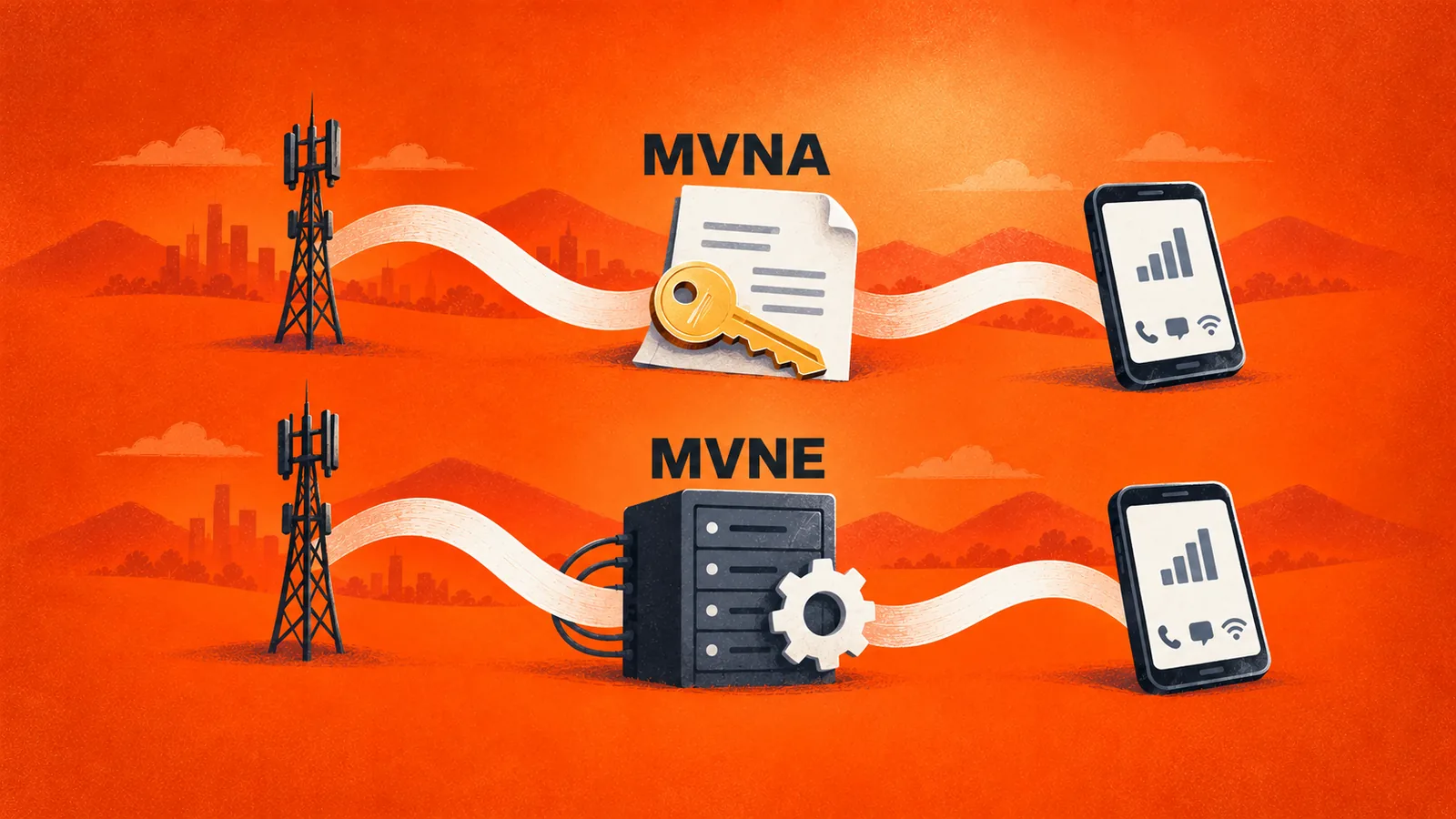
The label describes a role, not a product specification. An enabler might run shared systems for many brands, supply selected functions to an operator that already has a network agreement, or pair a platform with a managed operations team. The ITU’s 2021 report lists the four roles and notes that an MVNE can be seen as an MVNA with more capabilities, such as billing, provisioning, administration and OSS/BSS (ITU-D Question 4/1 output report, section 4.1). What a particular supplier includes still has to be read from its contract.
Quick test. If a company sells mobile service to end customers under its own brand, it is acting as an MVNO or MNO. If it builds and runs the systems that let another brand do that, it is acting as an MVNE. If it mainly buys network access in bulk and resells it to MVNOs, it is acting as an MVNA.
MNO, MVNO, MVNE and MVNA at a glance
The table answers the four ownership questions that decide most partner choices: who operates the radio network, who owns the customer, who runs the BSS and OSS, and who holds the wholesale access agreement. It shows the primary role of each party. A company may do more than the table says.
| Role | Radio network | Customer relationship | BSS and OSS | Wholesale access |
|---|---|---|---|---|
| MNO (mobile network operator) | Operates it, using licensed spectrum and its own or shared sites | Sells at retail, and often sells wholesale to others | Runs its own, end to end | Is the source; sells access to MVNOs and MVNAs |
| MVNO (mobile virtual network operator) | Uses a host’s radio access; does not own spectrum | Owns the brand, the price and the subscriber | Runs it, or buys it from an MVNE; a full MVNO also runs its own core network | Buys it from an MNO directly, or through an MVNA |
| MVNE (mobile virtual network enabler) | None needed | None; its customer is the MVNO | Builds and operates it for the MVNO | Depends on the contract: integrates your agreement, or arranges access for you |
| MVNA (mobile virtual network aggregator) | None | None directly; sells to MVNOs and resellers | Often limited, or provided with a partner | Holds the agreement with the MNO and resells it onward |
The Canadian regulator describes an MVNO as a provider that uses the spectrum and radio access network of another carrier, and in some cases other facilities or services, to deliver mobile service (CRTC, Mobile Virtual Network Operators). That “in some cases other facilities” clause is why an MVNO is not simply a company with no infrastructure, as the next section shows.
MNO vs MVNO: who owns the network?
An MNO operates the radio access network that connects devices over the air and holds the spectrum rights to do it. An MVNO sells service over a host’s radio access instead. The MNO controls coverage, capacity management and the engineering decisions behind them. The MVNO controls the offer: brand, plans, pricing, channels and support.
“Owns the network” is shorthand for who operates it. Towers, transport links and even spectrum can be leased or shared, so read it as the operating role. It also follows that buying wholesale access does not give the MVNO control of the host’s radio network. The agreement defines which coverage, services, interfaces and device types are available.
Light and full MVNOs
How much an MVNO operates itself varies. Ofcom’s statement on Global Titles describes MVNOs with their own core network equipment as “thick” or “full” MVNOs, and those without it as “thin” or “light” MVNOs whose service may be facilitated by an MVNE or MVNA (Ofcom, statement published 22 April 2025, section 2). A light MVNO leaves the core to someone else. A full MVNO operates its own, which gives more control over routing, identities and services and also more to run, test and secure. The MVNO types guide covers the models in depth.
| Question | Branded reseller or light MVNO | Full MVNO |
|---|---|---|
| Core network | Provided by the host or an MVNE | Operated by the MVNO |
| Subscriber identities and SIM profiles | Usually managed through a platform | Controlled directly, within the host agreement |
| Fits | Brands, device makers, software companies, MSPs | Operators with telecom engineering and a need for deep control |
Neither label settles price or quality. Retail pricing, traffic priority, roaming and device support come from the specific host agreement, so two brands on one host can sell different service. Compare the actual plan terms and test the intended use.
MVNO vs MVNE: who runs the service?
An MVNO is the customer-facing mobile provider. An MVNE is a supplier that helps it operate. The two are not alternatives: an MVNO often uses an MVNE, and the choice is between building the operating systems yourself and buying them. The MVNO normally owns the commercial decisions (offer, price, eligibility, customer communication). The MVNE performs the technical work its contract describes.
| Factor | MVNO | MVNE |
|---|---|---|
| Sells to | End customers, consumer or business | MVNOs and companies becoming one |
| Owns | Brand, subscriber relationship, pricing | Platform and operating processes |
| Typical work | Marketing, plans, support, partner management | Provisioning, rating, billing, SIM and eSIM lifecycle, network integration |
Outsourcing to an MVNE reduces what your team operates. It does not remove the work. Someone still has to configure plans, investigate a disputed usage record, tell customers about an incident and approve changes. A paid subscription whose device cannot connect crosses your checkout, the provisioning platform and the host network, yet the customer needs one accountable support route.
Handoff check. Ask any MVNE to demonstrate a failed activation: how it is detected, who investigates, who tells the customer and what status the order ends in. A successful activation shows the normal path. The failure shows whether the operating boundary is usable.
A software vendor is not automatically an MVNE. PortaOne’s FAQ, for example, states that the company supplies software and technical support and is not an enabler or aggregator (PortaOne MVNO FAQs). Buying a billing system can leave you responsible for the network agreement and the integration. For billing specifically, see the MVNO billing platform guide.
MVNE vs MVNA: technology or wholesale access?
An MVNE provides technology and operations. An MVNA provides wholesale network access, aggregated across many MVNOs. The MVNE answers “how do I run this service?” and the MVNA answers “how do I get network access on workable terms?” An MVNO with systems but no access route needs the second. An MVNO with a network agreement but no systems needs the first.
| Aspect | MVNE | MVNA |
|---|---|---|
| Primary offer | Platform and operations: provisioning, billing, SIM management, APIs | Wholesale access bought in volume and resold |
| Contract counterparty for the MVNO | The enabler, for platform and services | The aggregator, for network access |
| Relationship with the MNO | Integrates with networks; may not hold the wholesale contract | Holds the wholesale agreement and its commitments |
| Typical pricing basis | Platform, subscriber or transaction fees, or a revenue share | Wholesale rates with a margin, often tiered by volume or subject to minimums |
| Main risk to check | Scope: what is included, and what you still run | Terms: minimum commitments, service scope, who the counterparty is |
Aggregation can make a commercial relationship practical for smaller buyers. It is not proof of a better deal. Whether the price, minimum commitment and service scope suit you depends on the actual agreement. A combined supplier can provide both roles, so ask which company is the wholesale counterparty, which operates the systems and which issues your invoice. Separate agreements can sit behind one branded product.
Definitions vary by source
The roles are not defined identically everywhere. The ITU treats an MVNA as a body that aggregates small MVNOs to deal with an MNO, and an MVNE as an MVNA with more capabilities. Ofcom’s UK security statement uses the terms more narrowly: an MVNE acts solely as a supplier to an MNO, while an MVNA sells thin MVNO services directly to MVNOs, and both use their own core equipment. Those wordings serve their own regulatory purposes. Treat them as evidence that the contracting relationship matters more than the acronym, not as a universal product taxonomy.
What an MVNE actually provides
MVNE services connect a mobile offer to network activation, usage processing, billing and operational support. Each function needs an interface and a named owner. An accepted order does not prove that a customer can use the service, so check the outcome as well as the feature. The table pairs each common function with the question to ask in a demonstration.
| Function | What an MVNE may contribute | What to ask |
|---|---|---|
| Network integration | Interfaces to contracted mobile networks | Which networks, products and territories are available under my contract? |
| Provisioning | SIM and eSIM lifecycle: activate, suspend, swap, terminate | How is a completed activation told apart from a pending request? |
| Rating and billing | Plan catalog, usage rating, invoices, payments | Can one usage record be traced to its charge? |
| Customer and partner tools | Portals, APIs, reseller hierarchies | Can each role see only its permitted customers? |
| Operations | Monitoring, incident handling, escalation | Who resolves a failure outside the platform? |
These functions are the OSS and BSS of a mobile service: the systems that take an order, make the network deliver it and bill for it. The OSS and BSS guide explains the split. For eSIM, the relevant questions are device support, profile delivery and what happens after an interrupted setup, so ask to see the full activation on supported hardware rather than accepting a checkbox.
Benefits and trade-offs
The case for an MVNE is less integration work, a smaller operating burden and reusable billing and provisioning tooling. The trade-offs are dependency: release timing, custom work, support escalation and exit. A buyer may have less control over interfaces, and export limits can complicate a later move. Request the change procedure and a sample data export before committing, and compare total scope, including the staff you keep, rather than the setup invoice alone. A MVNE provider selection guide gives the longer evaluation, and the launch cost guide covers the budget.
Who should use what
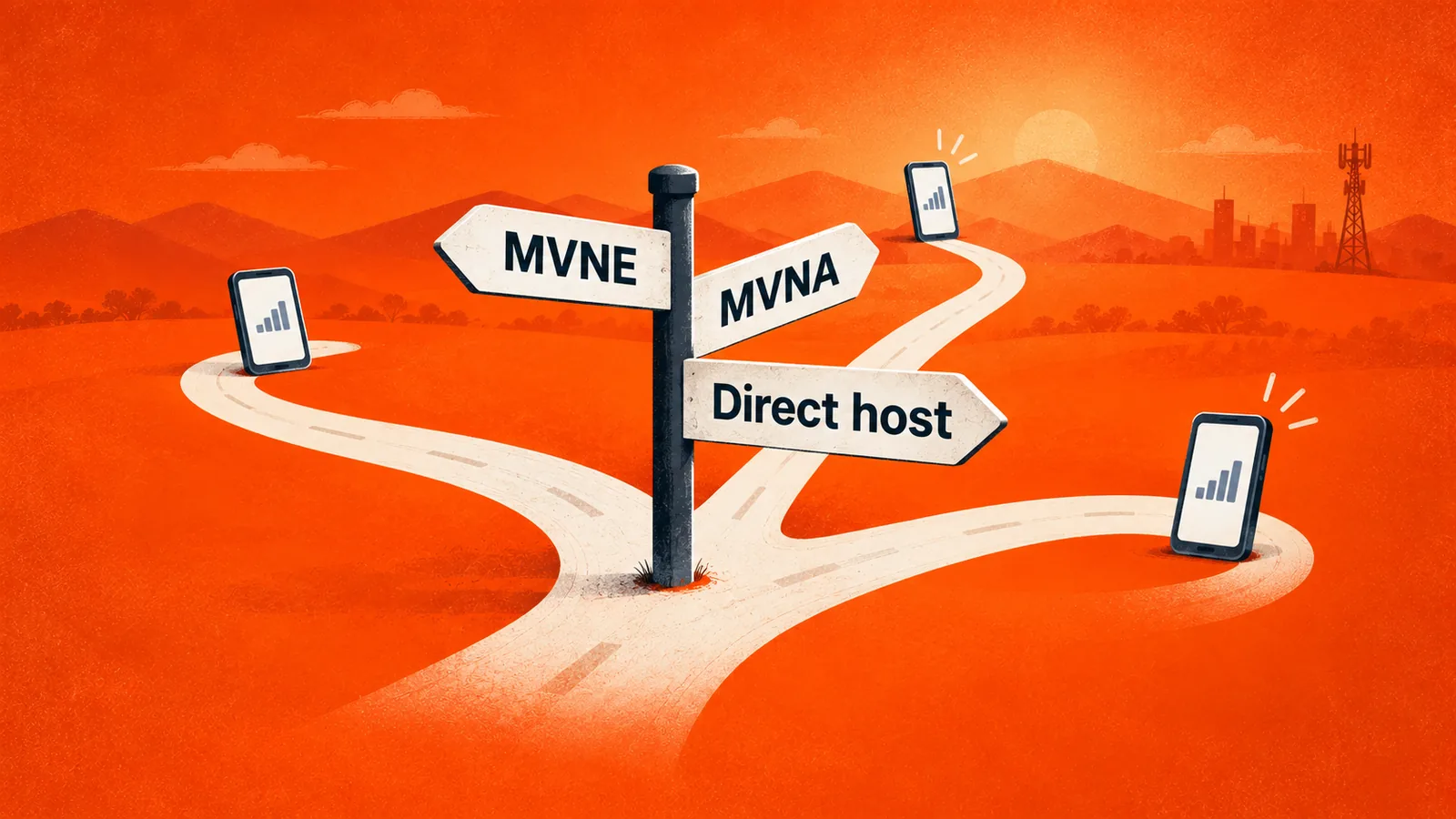
Start from what you already have, not from the acronym. The table maps common starting points to the partner type that closes the gap.
| Your situation | What is missing | Look first at |
|---|---|---|
| You have a network agreement but no operating systems | Provisioning, billing, care tooling | An MVNE |
| You have systems and engineers but no workable access route | Wholesale access at your volume | An MVNA, or direct host access |
| You have neither, and want one accountable supplier | Both access and systems | A combined MVNE and MVNA proposal, compared against separate suppliers |
| You have telecom engineering, volume and a need for deep control | Little; a direct host relationship fits | An MNO host agreement, run as a full MVNO |
| You sell a product (devices, software, services) and mobile is a feature | The telecom layer, behind your brand | An MVNE with white-label portals and APIs |
A software business may need mobile events inside its own application. None of these starting points automatically means becoming a full MVNO.
Which partner for which launch
Four short scenarios show the reasoning. The answer in each case depends on the quotes you actually receive.
A device maker bundling connectivity with hardware
The device ships with a SIM or eSIM and the customer should never see a carrier. The gaps are provisioning at scale, per-device billing and access in more than one country. This points to an MVNE with multi-network access, because buying one network at a time means one integration per market. If the maker also needs wholesale terms in one specific market, an MVNA or direct agreement can be added for that market.
An MSP adding mobile to its services
The MSP already bills its clients and needs to resell mobile under its own name. The main requirement is multi-level administration: client accounts, delegated portals and consolidated invoices. That is MVNE territory. Wholesale access can come bundled or through an aggregator, since an MSP rarely has the volume to negotiate a host agreement alone.
An enterprise building a branded mobile network
RocketPhone, a conversation-AI company for Salesforce users, needed native cellular calls tied into its own workflow and a way to administer enterprise and reseller accounts. Its published case study describes a branded business mobile network built on a platform, without a telecom stack of its own. The lesson is that a specific application requirement shapes the partner choice more than a generic preference for one acronym.
A funded operator planning a full MVNO
With telecom engineers, volume and a reason to control the core, the operator negotiates with an MNO directly and runs its own core. It may still buy BSS and OSS components or an MVNE’s platform for parts of the stack. The direct route can mean longer contract and integration work and minimum commitments, so the case has to justify the control. For the US process, see how to start an MVNO in the US.
How to compare partners
Whichever roles you buy, turn the labels into named responsibilities. Use one worksheet for every supplier, and treat “the partner handles it” as an unresolved item until a person and a procedure are attached.
| Task | Who performs it | Agree before signing |
|---|---|---|
| Network access | Host or contracted access provider | Eligible services, devices, territories and access terms |
| Activation | Provisioning platform and host integration | Failed-order route and final status |
| Billing | Rating, invoicing and finance teams | Usage reconciliation and correction history |
| Customer incident | Your support team and partner support | Contact owner and escalation record |
| Compliance and licences | You and your advisers, with partner tools | Who holds each obligation in your jurisdiction; get specialist review |
| Exit | Platform and account owners | Usable data export and transition assistance |
Compare cost the same way: by quoted units, not headline price. Ask each supplier for wholesale usage rates, minimums and deposits; platform charges per account, line or event, including inactive lines; implementation and acceptance work; and exit costs. The MVNO cost calculator helps organize assumptions, which you then replace with quotes. Set launch readiness against completed dependencies and accepted tests, not a role label’s supposed timeline.
Where Spenza fits
Spenza is an MVNE-style platform organized as three products: TelecomHub for operator access and SIM and eSIM provisioning, ControlHub for plans, pricing and reseller billing, and UXHub for the branded portal, checkout and self-service. It is operator-neutral and connects to many networks, which is the part of the MVNA role it covers, and the MVNE platform page and the white-label MVNO guide describe the options. As with any supplier, test the failure path and the data export before relying on it.
Conclusion
The four roles divide one job: operate the radio network (MNO), sell the service (MVNO), run the systems behind it (MVNE) and package wholesale access (MVNA). Most brands entering mobile are choosing between buying systems and access separately, buying them together, or building more themselves. Decide which responsibilities you must keep, check what access and systems you already have, and replace each acronym in a proposal with a named owner, a contract term and an acceptance test.
The most useful proposal is the one your team can operate and verify. Keep unresolved dependencies visible until the responsible party supplies evidence, and plan the launch against finished work.
FAQs
What is an MVNE?
An MVNE (mobile virtual network enabler) supplies the technology and operations a mobile brand needs to run service: provisioning, SIM and eSIM management, billing and network integration. It does not sell service to the public under its own brand. Its customer is the MVNO, or a company becoming one.
What is the difference between an MNO, MVNO, MVNE and MVNA?
An MNO operates the radio network. An MVNO sells mobile service under its own brand over a host’s radio access. An MVNE supplies the systems and operations an MVNO needs. An MVNA aggregates wholesale network access and resells it to MVNOs. One company can fill several of these roles.
What is the difference between an MVNE and an MVNA?
An MVNE provides technology and operations such as billing and provisioning. An MVNA provides aggregated wholesale network access and holds the agreement with the network operator. A combined supplier can offer both, so check which company is the wholesale counterparty and which operates the systems.
What is the difference between an MVNO and an MVNE?
An MVNO is the customer-facing mobile provider and owns the brand, pricing and subscriber relationship. An MVNE is a supplier that provides systems and operations to that provider. They are not competing models: an MVNO can use an MVNE, or build the same capabilities itself.
Can an MVNO operate without an MVNE?
Yes, if it has the systems, integrations and staff its service needs, internally or from other suppliers. Skipping an MVNE does not remove provisioning, billing, customer care or the need to coordinate with the host network. It moves that work to your team.
Does an MVNO own any network infrastructure?
It can. An MVNO relies on a host for radio access and spectrum, but a full MVNO can operate its own core network functions, billing and customer systems. A light MVNO or branded reseller leaves most of those to a host or an MVNE. Check the architecture rather than assuming none.
Does an MVNE provide wholesale network access?
Sometimes. Some MVNE arrangements include access to contracted network products, and others integrate with an agreement you already hold. Ask for the networks, territories, contracting parties and exclusions in writing before assuming access is included.
Is an MVNA always the cheapest way to launch?
No. An MVNA can make access practical for smaller buyers, but the cheapest suitable arrangement depends on the quoted scope. Compare minimum commitments, usage rates, platform fees, implementation and the work your team keeps, since a low access rate can sit alongside other costs.