


What is an MVNO Billing Platform?
An MVNO billing platform or billing software is the system that manages how a mobile virtual network operator (MVNO) charges its customers and tracks usage. It handles rates and charges, subscriber activation, wholesale reconciliation with mobile network operators, and the overall customer billing experience.
Think of it as the financial nervous system of any MVNO business. Without it, you cannot charge customers, reconcile costs with your host carrier, or scale your mobile services beyond a handful of users.
If you are exploring the MVNO space for the first time, here is the simplest way to think about it: imagine opening a coffee shop inside someone else’s building. You use their kitchen, their electricity, their space. But you still need your own cash register, your own pricing menu, and your own receipts for customers. The billing platform is that cash register. It sits between what your host carrier charges you wholesale and what you charge your end customers at retail.
Short on time? Skip ahead to the Top MVNOs Billing Platforms Complete Comparison
How MVNO Billing Works: The End-to-End Flow
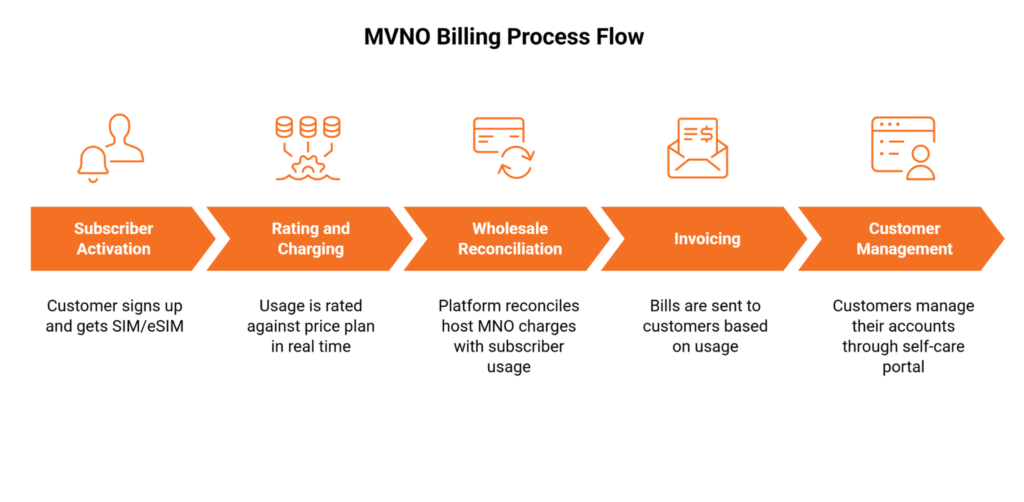
The billing journey inside an MVNO follows a fairly consistent path, regardless of which platform you use. These billing processes form the core business process behind delivering reliable mobile services to end customers.
- Subscriber activation: A customer signs up and gets a SIM or eSIM provisioned on the network.
- Rating and charging: Every call, text, and megabyte of data consumed gets rated against a price plan in real time.
- Wholesale reconciliation: Your platform reconciles what your host MNO charges you (in bulk) against what your subscribers actually used.
- Invoicing: Bills go out to customers based on their plan, usage, and billing cycle.
- Customer management: Customers can top up, change plans, raise disputes, or cancel through a self-care portal.
These billing processes happen continuously, often millions of times per day for larger operators. A weak billing system creates errors at every stage. That means unhappy customers, revenue leakage, and compliance headaches.
According to GSMA Intelligence , there are over 1,000 active MVNOs globally, and the U.S. MVNO market was valued at approximately $30 billion in 2024, projected to exceed $52.9 billion by 2032.
MVNO vs MVNE vs MVNA: Who Needs What Kind of Billing?
These three acronyms confuse almost everyone entering the mobile services world. Here is a clean breakdown of how billing platform needs differ across each role.
| Role | What They Do | Billing Need |
|---|---|---|
| MVNO | Sells mobile services directly to end customers | End-customer billing, invoicing, self-care |
| MVNE | Provides the backend technology stack to MVNOs | Multi-tenant white-label billing, wholesale reconciliation |
| MVNA | Acts as an aggregator between MNOs and MVNOs | Wholesale rate management, margin billing |
A branded retailer launching their own SIM service is an MVNO. A company like Spenza, which powers other brands to become MVNOs, operates as an MVNE. An MVNA sits even further upstream, negotiating bulk rates from carriers and passing them down to MVNEs and MVNOs.
Knowing which role you are playing determines which type of billing system you actually need.
Must-Have Features in an MVNO Billing System
Not all billing systems are created equal. Before evaluating any vendor, run through this checklist.
- Convergent rating engine: Handles voice, data, and SMS under one unified logic.
- Prepaid and postpaid support: Both models in a single system, not separate silos.
- Real-time charging: Deducts balance or notifies customers as usage happens.
- Product catalog management: Lets you create, modify, and launch new plans quickly.
- Wholesale reconciliation: Matches your MNO invoice against subscriber usage automatically.
- Multi-carrier support: Critical if you plan to operate across more than one host network.
- eSIM and SIM lifecycle management: Provisioning, swapping, suspending, and terminating profiles.
- Customer self-care portal: Reduces support tickets and improves customer experience.
- Tax engine integration: Telecom tax is complex; platforms need to plug into engines like Avalara or Vertex.
- API access: Connects your billing system to CRM, ERP, and e-commerce platforms.
- Analytics and reporting: Usage trends, revenue reports, churn signals.
Ultimately, these features directly impact customer experience, especially when it comes to real-time usage visibility and billing accuracy.
If a vendor claims full feature support but cannot demonstrate real-time charging in a live product walkthrough, treat it as a red flag. Real-time charging is highly complex to implement and is often the first capability removed in lower-cost solutions.
Top MVNO Billing Platforms Compared (2026)
Here is an honest look at the major platforms in the market. This is not a ranked list. The right platform depends entirely on your scale, budget, and speed requirements.
| Platform | Best For | Strengths | Weaknesses | Pricing Band |
|---|---|---|---|---|
| Spenza | Branded resellers, IoT MVNOs, fast launchers | API-first, 7-day launch, per-line pricing, eSIM-native | Not suited for very early startups | Per-line OpEx model & Custom pricing |
| Amdocs CES | Tier-1 MNOs and large MVNOs | Battle-tested, massive feature set | Expensive, long implementation | $500K–$2M+/year |
| Oracle BRM | Enterprise telcos | Deep financial controls | Complex to configure and maintain | $500K–$1.5M+/year |
| Netcracker | Large-scale operators | Strong OSS/BSS integration | Not suited for small MVNOs | Enterprise-only, $500K+ |
| Cerillion Skyline | Mid-size MVNOs | Modern UI, modular | Requires an implementation partner | $50K–$300K/year |
| Comarch BSS | European MVNOs | Regulatory compliance strength | Less common in the US market | $50K–$500K/year |
| Plintron | Full-MVNO enablement | Turnkey solution | Less flexibility for customization | Custom pricing |
| Totogi | API-first cloud MVNOs | Cloud-native, fast setup | Newer, smaller track record | Per-subscriber pricing |
| PortaBilling | Small to mid MVNOs | Affordable, open architecture | Dated UI, DIY-heavy | $10K–$50K/year |
| BillRun | Tech-savvy operators | Open source, no license cost | Requires in-house ops | Free + infrastructure |
| Tridens | Subscription-based MVNOs | Strong recurring billing logic | Heavily self-promotes | Mid-tier custom |
| Telgoo5 | US-based MVNOs | Carrier-certified, US-focused | Less global coverage | Custom pricing |
Choosing the right MVNO billing solution or platform comes down to how well the system fits your operating model and integrates with your existing workflows. The table above provides a starting point, but the best choice ultimately depends on your specific use case.
A Real-World Example:
A D2C electronics brand that wants to bundle a SIM plan with its smart home device does not need Amdocs. That would be like hiring a commercial airline catering team to make sandwiches for a family picnic. Spenza ControlHub or Totogi would be far more appropriate: faster to deploy, lower upfront cost, and designed for exactly that kind of branded reseller use case.
MVNO Billing Platform Pricing: What to Actually Expect
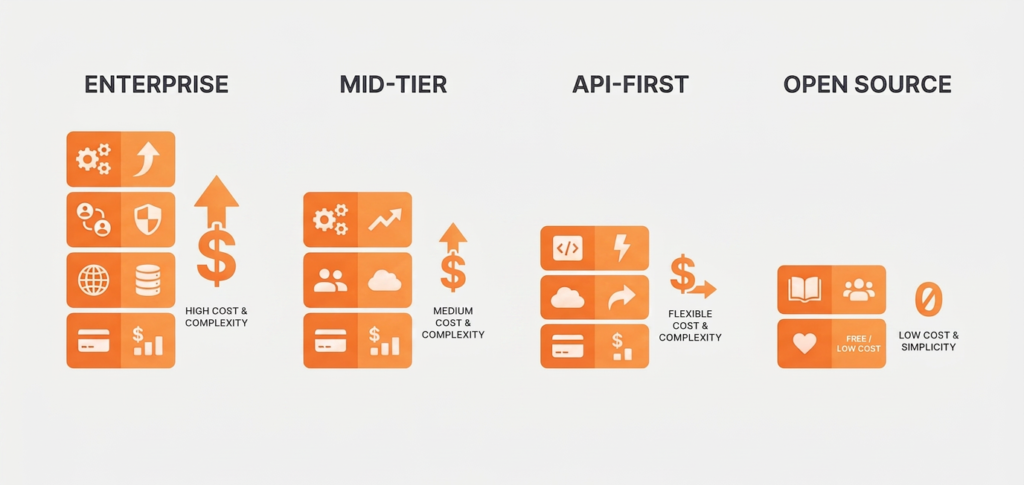
The cost of an MVNO billing system varies significantly depending on the complexity of billing processes and the scale of mobile services offered. Pricing in this space is intentionally opaque. Most enterprise vendors do not publish rates. Here is a realistic breakdown by tier.
1. Enterprise tier ($500K–$2M+/year)
Amdocs, Oracle BRM, Netcracker. These platforms are built for operators running millions of subscribers. The pricing reflects months of implementation, dedicated support teams, and deep customization. If you are a startup or a branded MVNO with under 100,000 subscribers, these are not your options.
2. Mid-tier modular ($50K–$500K/year)
Cerillion, Comarch, Plintron. More accessible, but still requires significant implementation effort and usually an integration partner. Good for MVNOs that have confirmed product-market fit and are scaling.
3. API-first per-line (OpEx model)
Spenza ControlHub, Totogi. No massive upfront CapEx. You pay per active line or subscriber. This model is ideal for brands launching fast and needing flexibility as they grow. Spenza, for instance, can get an MVNO operational in as little as 7 days.
4. Open source (free software, ops cost)
BillRun. The software is free, but someone needs to host, maintain, and operate it. Viable for technically strong teams who want full control.
According to Analysys Mason , MVNO launches are accelerating in markets where low-code and API-first enablement platforms reduce the technical barrier to entry. time-to-market is now a primary competitive factor.
Integration Requirements and Supported Carriers
A billing platform that cannot connect to your other systems is a walled garden. B2B buyers evaluating platforms should ask specifically about these integration categories.
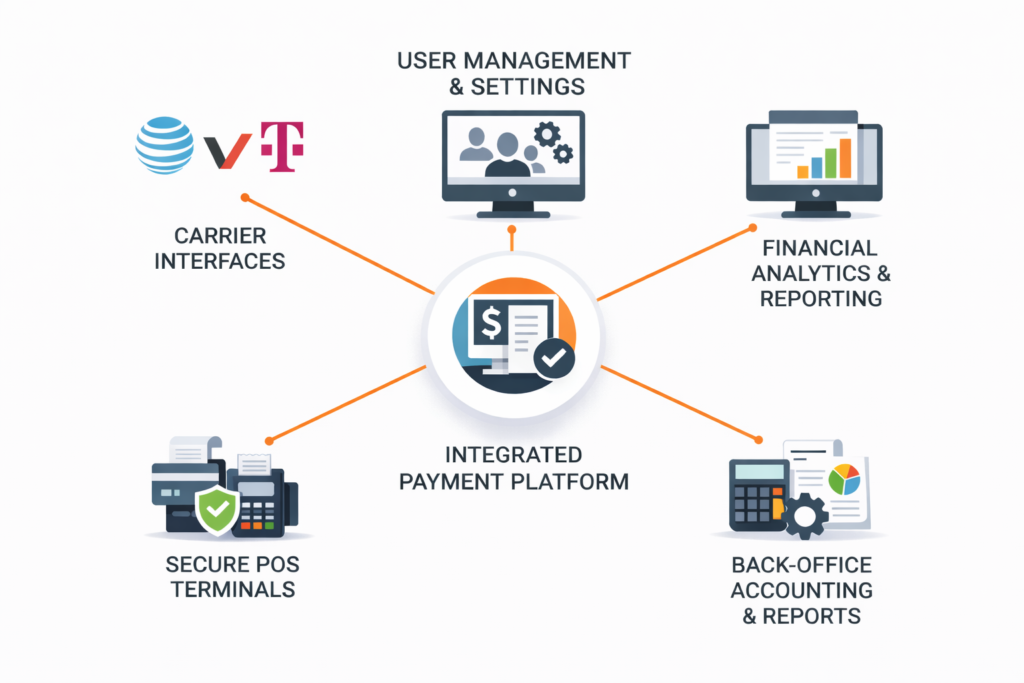
1. Host carrier integration
Your BSS solution needs certified connections to your host MNO. In the US, that typically means AT&T, Verizon, or T-Mobile. Platforms like Spenza ControlHub have pre-built integrations with major carriers, which cut months off implementation timelines.
If you are unfamiliar with how OSS and BSS systems work together in a telecom stack, this OSS/BSS overview is a good place to start before evaluating any billing platform.
2. CRM and ERP systems
Salesforce, HubSpot, NetSuite. Your billing system should push subscriber data into your CRM without manual exports.
3. Payment gateways
Stripe and Adyen are the most common. If your platform cannot connect to a modern payment gateway natively, expect workarounds.
4. Tax engines
Avalara and Vertex handle the nightmarish complexity of telecom tax across US states and international markets.
5. eSIM platforms
If you are launching with eSIM support, the billing platform needs to interface with SGP.32 eSIM orchestration. This is increasingly non-negotiable as physical SIM usage declines.
Since MVNOs rely on multiple mobile network operators for network access, seamless integration becomes critical for accurate billing and service delivery.
How to Choose by Buyer Type
Here is a simple decision framework based on your telecom solutions/services.
| Buyer Type | Recommended Platform(s) | Why |
|---|---|---|
| Enterprise MNO or large MVNO | Amdocs, Oracle BRM | Scale, compliance, support |
| Mid-size MVNE operator | Cerillion, Comarch | Modular, manageable cost |
| Branded reseller or fast-launch MVNO | Spenza, Totogi | Speed, flexibility, API-first |
| IoT-focused MVNO | Spenza, Tridens | Machine-to-machine billing logic |
| Open-source preference | BillRun | Cost control, technical ownership |
The table above is a helpful starting point, but every business has its own nuances. A brand launching its first connected product with a bundled SIM plan has very different needs from an operator managing millions of subscribers. The right platform is one that fits your current scale comfortably while leaving room to grow alongside your business over time.
Time-to-Launch Comparison
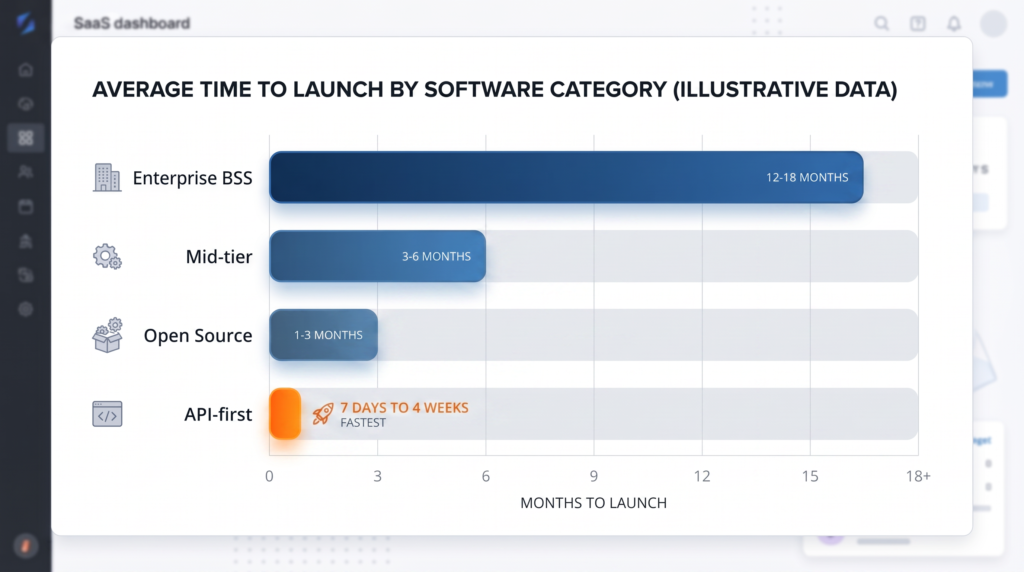
One of the most misleading phrases in telecom is “fast deployment.” Every vendor says it. Almost none quantify it. Here is the reality based on market experience.
| Platform Type | Typical Time-to-Launch |
|---|---|
| Traditional enterprise BSS (Amdocs, Oracle) | 12–18 months |
| Modular mid-tier (Cerillion, Comarch) | 3–6 months |
| Modern API-first (Spenza, Totogi) | 7 days to 4 weeks |
| Open source self-hosted (BillRun) | 1–3 months (technical team required) |
For a branded retailer or IoT company, the difference between 12 months and 7 days is not just operational. It is the difference between catching a market window and missing it entirely.
Spenza’s MVNE platform is designed for brands that need to launch quickly without sacrificing billing accuracy or carrier compliance. Its per-line pricing model allows you to scale without being locked into enterprise-level costs before reaching enterprise-scale volumes.
IoT and eSIM Billing Considerations
IoT billing is fundamentally different from consumer mobile billing, and many legacy platforms are not built for it.
Consumer billing typically involves a few thousand events per subscriber per month. IoT billing can involve millions of micro-events from a single device fleet; most of them are low-value and machine-generated. A smart parking sensor does not consume the same billing logic as a human smartphone user.
Key differences to understand:
- Rating logic must handle massive volumes of tiny events without collapsing
- Multi-IMSI and eSIM support is essential for global deployments
- Plan flexibility matters because IoT devices have wildly different data consumption profiles
- Automated management of dormant or stranded devices prevents billing waste
Platforms like Spenza’s IoT connectivity management solution are purpose-built for this use case, combining eSIM lifecycle management with billing logic designed for machine-to-machine environments.
Implementation Checklist and Red Flags
Before signing any contract, verify the following.
Green lights to look for:
- Carrier certification documentation (not just a claim)
- Uptime SLA of 99.9% or higher in writing
- Real-time charging demo with live data
- API documentation that is publicly accessible or available on request
- References from live MVNO deployments, not pilots
Red flags to walk away from:
- No published SLA or vague “best effort” language
- The vendor cannot name a live customer in your target segment
- Integration requires 6 months of professional services before you see anything working
- Pricing requires a full CapEx commitment before proof of concept
Conclusion
Choosing the right MVNO billing platform comes down to three variables: your scale, your budget, and how fast you need to move. Enterprise operators with millions of subscribers and complex regulatory requirements should evaluate Amdocs or Oracle. Mid-size operators building out an MVNE layer should look at Cerillion or Comarch. If you are a branded reseller, a D2C company bundling connectivity with a product, or an IoT company managing device fleets across multiple countries, an API-first platform built for speed and flexibility is the smarter starting point.
Spenza ControlHub is built specifically for that last category. Per-line pricing, 7-day launch timelines, carrier-certified integrations, and native eSIM support make it a strong fit for brands that want to move fast without the overhead of traditional BSS implementations.
Whether you choose a traditional BSS solution or a modern MVNO billing platform, aligning your billing system with your business model is key to long-term success.
FAQs
Want help choosing or switching your billing engine? Consult Spenza today to transform your MVNO billing platform.


