Introduction
Choosing the right MVNO BSS provider is critical because billing, customer management, subscriptions, products, orders, and payments directly affect the day-to-day operation of an MVNO.
A modern BSS should do more than generate invoices. It should support usage-based billing, flexible plan and product management, customer and account hierarchies, payment processing, integrations, and the ability to scale as subscriber and service volumes grow.
This guide explains what to look for in an MVNO BSS provider, which billing and BSS capabilities matter most, how BSS differs from OSS, and what to evaluate before choosing a platform.
This blog will walk through what to look for in an MVNO BSS provider. You’ll find out which features matter most, why technical flexibility is key, and how modern tools like Spenza can support your operations.
What Is an MVNO BSS Provider?
An MVNO BSS provider supplies the business support systems an MVNO needs to manage customers, products, subscriptions, orders, billing, invoicing, payments, and revenue operations. A strong MVNO BSS platform should also support usage-based charging, plan management, integrations, and scalable telecom operations.
Why MVNOs Need Billing & BSS Solutions
Running an MVNO is no longer just about reselling mobile services. It’s about building a service that feels native, smart, and fast. That’s where a proper BSS for MVNOs comes in.
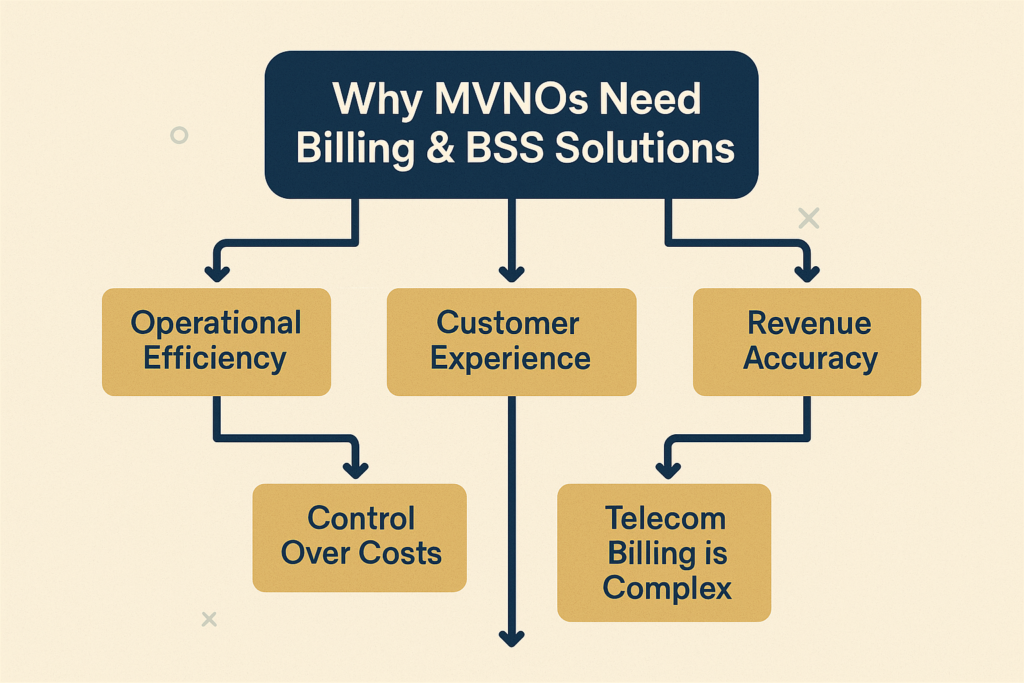
1. Operational Efficiency: MVNO operations include real-time plan updates, customer onboarding, SIM management, and plan provisioning. Without automation, these tasks slow everything down. A good MVNO billing system cuts out delays.
2. Customer Experience: Today’s users want instant service. They expect real-time data tracking, usage control, and billing clarity. A top telecom billing software makes onboarding smooth and billing transparent. Also, with features like self-service portals, users manage their plans with ease.
3. Revenue Accuracy: Billing errors cost money. The right billing solutions for MVNOs ensure exact usage tracking and correct invoicing. No more leakage. This is key when you operate on thin margins.
4. Scale Without Trouble: You want to grow. You may expand to enterprise clients or new geographies. Your BSS must handle high volumes and new features without causing issues.
5. Control Over Costs: Wireless expenses can skyrocket if you don’t watch usage. Good wireless expense management (WEM) features flag overspend quickly. Spenza helps overcome these common WEM challenges by offering live spend insights and automation.
6. Telecom Billing is Complex: Unlike simple SaaS billing, telecom involves usage-based pricing, roaming, tiered plans, and multi-currency invoicing. Your MVNO BSS provider must support all these without slowing you down.
Why Modern MVNO BSS Needs to Be Flexible
Modern telecom BSS is moving beyond traditional billing and customer management toward more programmable, API-driven platforms. Current industry discussions highlight the need for faster product launches, simpler integrations, and greater flexibility as MVNOs expand into 5G, IoT, eSIM, and other digital connectivity services.
For MVNOs, this makes API readiness, product catalog flexibility, real-time usage data, and integration capabilities important considerations when evaluating a BSS provider.
Key Features to Look For in an MVNO Billing & BSS Provider
Choosing a BSS isn’t only about features. It’s about finding the right tool that fits into your daily operations. Let’s explore what really matters.
1. All-In-One Connectivity & Billing System
Don’t use separate systems for billing and connectivity. That’s a recipe for errors. Look for a platform that combines them. A procure-to-pay SaaS should come with an integrated marketplace for mobile plans. You need to control everything from one dashboard: operator switching, SIM provisioning, and billing.
Spenza makes this possible. We combine operator-neutral connectivity with billing into a single pane of glass. You can actively control usage, import invoices, and manage connectivity, all in one place.
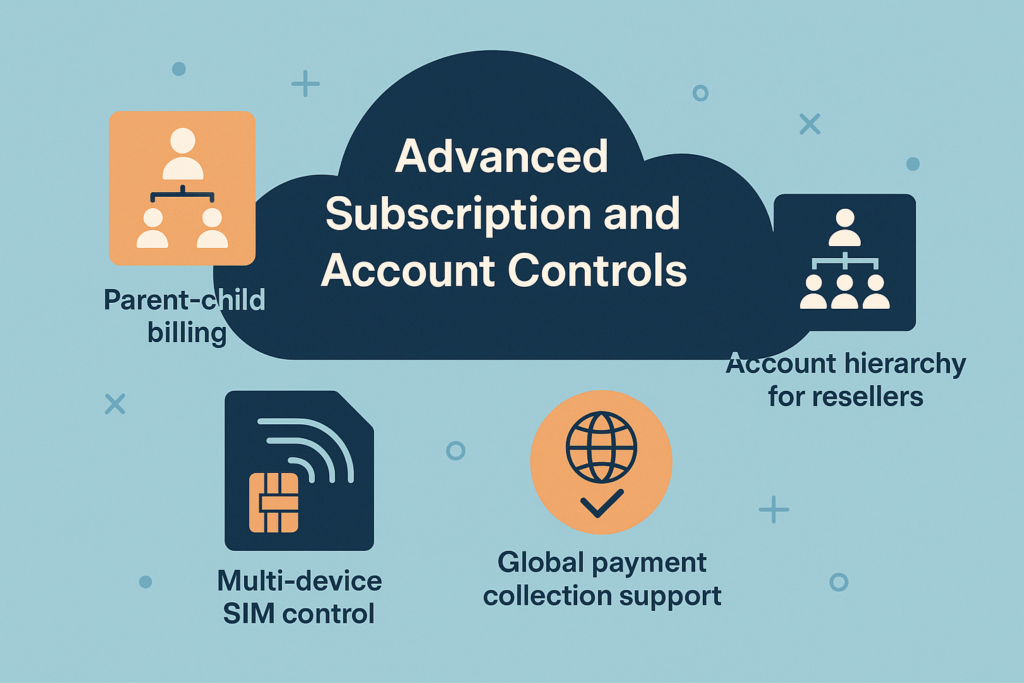
2. Advanced Subscription and Account Controls
As your subscriber base grows, things get messy. Managing hundreds or thousands of subscriptions across devices and users needs a strong subscription management telecom solution.
Look for:
- Parent-child billing
- Account hierarchy for resellers
- Multi-device SIM control
- Global payment collection support
You can explore how Spenza’s TaaS platform supports these billing needs.
Spenza lets you do just that. Manage enterprise customers, resellers, and individuals in a structured way. We support parent-child billing and cross-border subscription payments.
3. Custom Plan Creation and Product Catalog Flexibility
No two customers are the same. Your platform should support custom mobile and IoT plans. You might serve a low-data GPS tracker and a high-data industrial sensor. Your MVNO billing system must support both.
Features to look for:
- Modular plan builder
- Custom usage triggers (throttling, alerts)
- Plan templates for quick rollout
- Local vs. roaming plan management
Spenza offers a marketplace of mobile plans from various operators. You can customize any plan and serve niche devices. That’s why partners like Angel Watch and Butlr choose us.
4. Real-Time Usage and Cost Optimization (WEM)
Here’s where wireless expense management (WEM) comes in. You must see how data is being used right now, not at month-end. Real-time control prevents surprise charges.
Key tools include:
- Pool optimization
- Usage-based billing triggers
- Mid-cycle plan adjustments
- Invoice imports with automation
With Spenza, we help users save up to 30% on mobile costs. APIs connect directly to usage data, letting us adjust plans before you overspend.
5. API-Ready and Fully Integrated
You already use CRM, ERP, or e-commerce tools like Shopify. Your API integration telecom feature should connect with all of them. Spenza’s TEM APIs bring seamless automation into enterprise workflows. Manual syncing is slow and creates errors.
Look for:
- Webhook triggers
- Open API documentation
- Integration support for payment and CRM systems
- Automated sync tools
Spenza comes API-first. That means it’s ready to plug into your stack from day one.
6. Branded Experience with White-Labeling
Selling under your name builds trust. That’s why white-label billing matters. Check out Spenza’s complete guide on launching a white-label MVNO to see how this boosts brand trust. Your customers or resellers should only see your branding, not your provider’s.
Choose a system that:
- Lets you apply your logo and brand colors
- Offers custom domains for self-service portals
- Supports partner branding for resellers
With Spenza, we help MVNOs launch their own brand experience. Your end user only sees your name.
7. Scalability Meets Security
Security isn’t optional. Neither is growth. Your BSS must support both. From handling hundreds of transactions per second to being compliant with SOC2 and GDPR.
Look for:
- Cloud-native deployments
- Enterprise-grade encryption
- Regional data hosting options
- Disaster recovery and failover support
8. Operator-Neutral Access
Working with one MNO limits your control. Operator neutrality gives you the edge. It brings better rates, global access, and uptime.
Features to check:
- Support for multiple carriers
- Multi-SIM / eSIM profiles
- IoT platform compatibility
Spenza offers operator-neutral access in one place. A single SIM works across carriers.
What Is the Difference Between BSS and OSS for MVNOs?
BSS and OSS serve different but complementary functions in an MVNO. BSS manages the commercial and customer-facing side of the business, including customers, subscriptions, products, orders, billing, invoicing, payments, and plans. OSS manages the technical delivery of services, including provisioning, SIM activation, device authentication, network operations, and service assurance.
In simple terms, BSS manages what is sold, who buys it, and how it is billed, while OSS manages how the service is delivered and maintained.
OSS takes care of service delivery and network functions.
For example, if a customer signs up for a mobile plan, the BSS sets up their billing profile, applies taxes, generates the invoice, and stores the customer’s plan data.
The OSS ensures that the SIM card gets activated, the device connects to the right network, and the service works without interruptions.
An MVNO without a strong OSS may face SIM activation failures or dropped connectivity. Without strong BSS, it can’t bill customers properly or manage plan upgrades.
Together, they form the backbone of MVNO operations. But not all vendors offer both. When choosing a MVNO BSS provider, ensure they work well with your OSS or provide OSS services too.
Spenza: Your Comprehensive OSS/BSS Partner for MVNOs
At Spenza, we build for real MVNO problems. Our unified platform combines both OSS (Operational Support Systems) and BSS (Business Support Systems) to give you full control over your connectivity and customer experience. From network operations to billing, we streamline it all in one powerful product.
You get seamless service management, real-time cost tracking, global support, and the flexibility to operate how you need. We’ve helped customers like Angel Watch launch low-data plans worldwide, and supported Butlr in managing high-bandwidth smart devices across markets. Both scaled fast using our integrated tools.
Our team understands the daily pain points, SIM tracking, spend control, plan customization, and we’ve built solutions to make them easy. No clutter. Just clean, reliable software that works.
Conclusion: Choose Wisely, Build Strongly
A solid MVNO BSS provider keeps your business running. You can support customers better, fix billing gaps, and grow without limits. Don’t choose by features alone. Think about fit, flexibility, and future plans. Spenza offers all this and more.
Remember, your BSS isn’t just a system, it’s a strategic partner in your success. The right choice empowers you to innovate, respond quickly to market demands, and deliver exceptional customer experiences. Take the time to evaluate not just what a provider offers, but how they’ll support your journey from launch to leadership in the MVNO space.
FAQs
Ready to simplify your telecom operations? Choose the right MVNO BSS provider now. Contact us to see how our tools help you manage billing, subscriptions, and cost, faster and smarter.